Most business directors believe their data is backed up.
Many only find out the gaps when something goes wrong.
Disaster recovery is often seen as an IT problem, but in reality it is about one simple question.
Can your business still operate if something unexpected happens?
That unexpected event might be a cyber attack, a fire, a flood, theft, or even a power outage. When it happens, the speed at which you can recover determines how serious the impact is on your business.
What Disaster Recovery Really Means
Disaster recovery is not just about having backups.
It is about:
-
How quickly your systems can be restored
-
How much data you can afford to lose
-
Whether staff can continue working
-
How long customers are affected
For directors, this is a risk and continuity issue, not a technical one.
The Risk of Relying on One Type of Backup
Many businesses believe they are protected because they have backups. The problem is that those backups often exist in only one place.
Local backups only
Local backups are usually stored on a device in the office such as a server or network storage.
They are fast to restore and excellent for everyday issues like accidental deletion or hardware failure.
However, they do not protect you if:
-
The building is damaged or inaccessible
-
Equipment is stolen
-
Ransomware encrypts everything on site
If the office is lost, local backups are often lost with it.
Cloud backups only
Cloud backups store data securely off site.
They are essential for protecting against major incidents, but they are not always fast to restore and they can still be affected by:
-
Internet outages
-
Account lockouts
-
Large data restores taking days rather than hours
Cloud backups alone can still mean long periods of downtime.
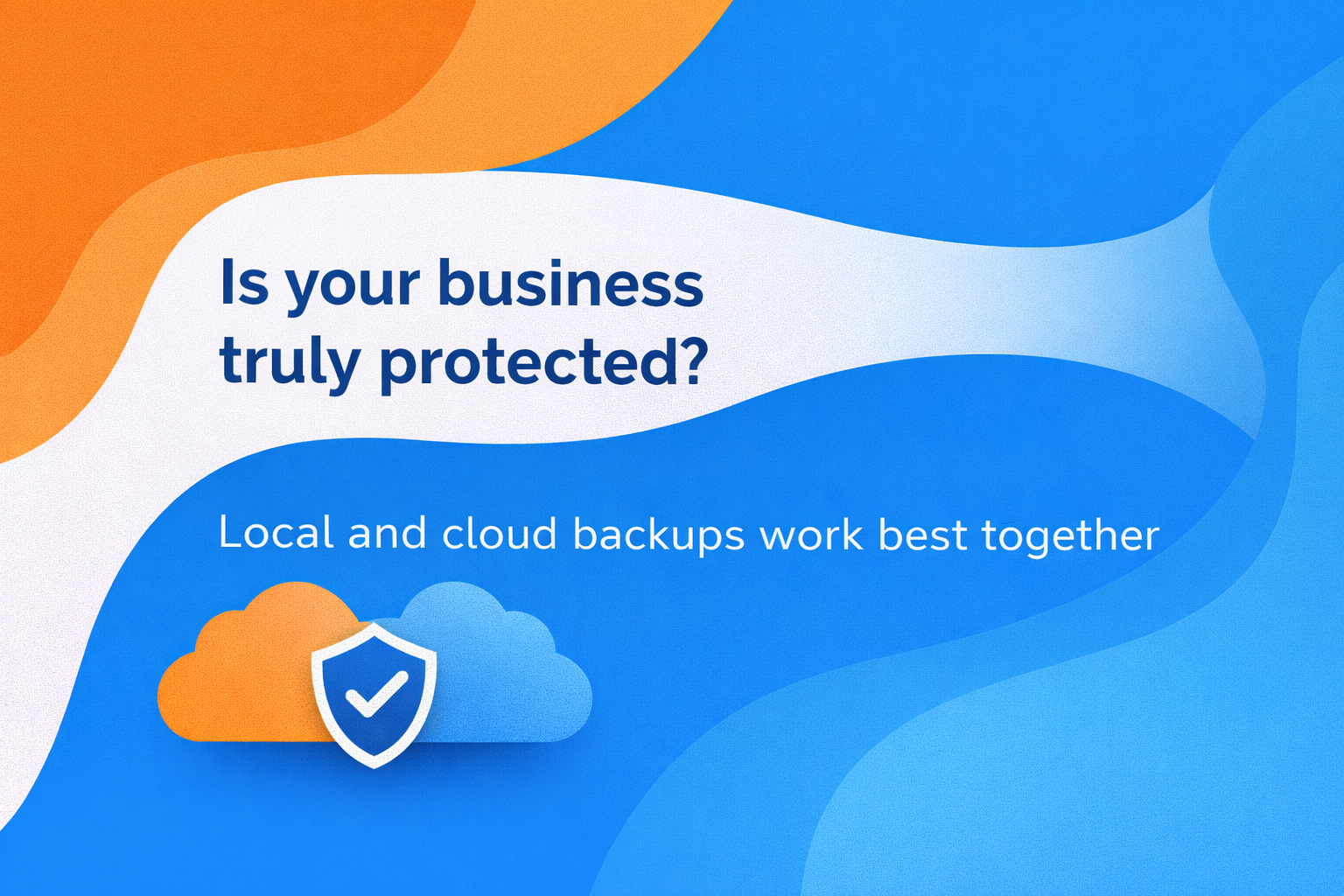
Why Local and Cloud Backups Work Best Together
Businesses that recover quickly use both local and cloud backups.
Local backups allow fast recovery so staff can get back to work quickly.
Cloud backups protect the business if the site itself is unavailable or compromised.
Together, they provide:
-
Speed
-
Protection against major incidents
-
Confidence that data is not stored in just one place
This approach is what turns backups into true disaster recovery.
What Directors Should Be Asking
You do not need to understand the technology to understand the risk. These are the key questions every director should ask:
-
How long could the business realistically operate without systems
-
How much data could we afford to lose
-
Are backups stored in more than one location
-
How often are backups tested
-
Who is responsible if something goes wrong
If you cannot get clear answers to these questions, there is likely a gap in your protection.
Final Thoughts
Disaster recovery is not about planning for the worst.
It is about making sure the business can continue when something unexpected happens.
Backups are not just an IT safety net. They are a business resilience decision.
If you would like help reviewing your current setup or understanding whether your business is truly protected, we are happy to have a simple, no pressure conversation.